
What We See, What God Sees
Supporting Scripture: Romans 8:28, 38–39
Introduction: Reality Changes Depending on How We See It
The same event can look different depending on our perspective. We often judge situations based on our own feelings and experiences. But what we see and understand is not everything.
Today, the story of Lazarus shows us how our perspective can be different from God's greater plan.
First, We Must Look Beyond Our Present Circumstances and See God's Greater Plan.
1. From a human perspective, it was a time of suffering and death.
Lazarus became seriously ill. His sisters, Martha and Mary, asked Jesus for help.
Jesus loved the family, but He did not come immediately (John 11:3–6). Lazarus eventually died.
Martha and Mary told Jesus that their brother would not have died if He had been there (vv. 21, 32).
For them, this was a painful and confusing time.
2. But Jesus saw the life that would be revealed through the event.
Jesus said that God's glory would be revealed through what happened (v. 4). He also knew that His disciples would believe because of it (v. 15).
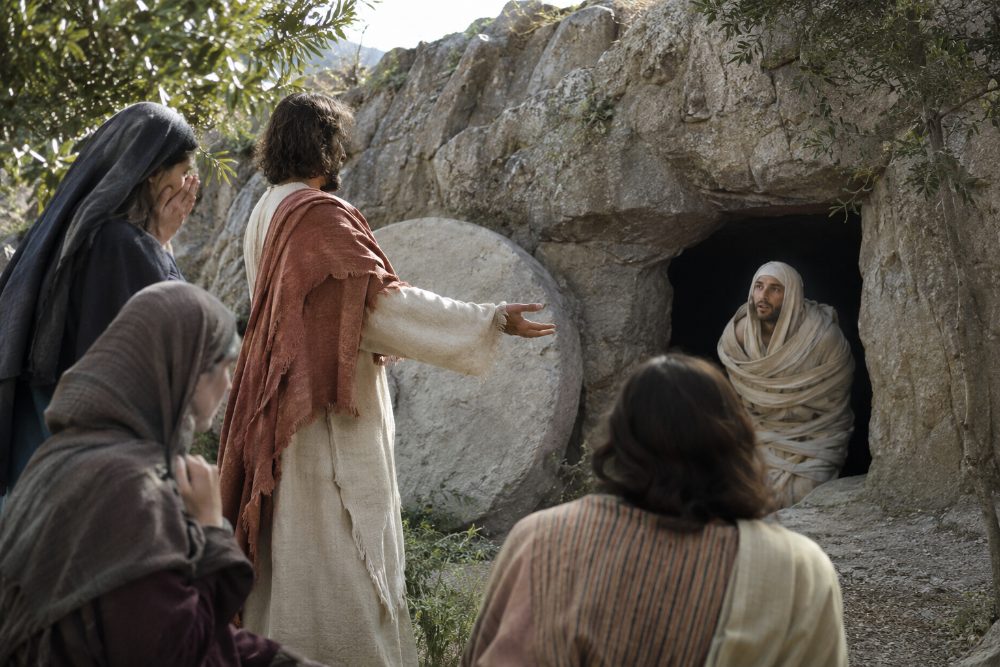
Before raising Lazarus, Jesus thanked God the Father (v. 41). Then He called Lazarus out of the tomb, and Lazarus came back to life.
Many who witnessed the miracle believed in Jesus (vv. 43–45).
What seemed like a time of death and sorrow became a time when many people came to believe in Jesus. The raising of Lazarus also pointed ahead to Jesus' own resurrection.
3. Jesus' love looked toward God's greater plan.
Jesus did not ignore the family's suffering. He loved them and wept with those who were grieving (v. 35).
He cared about their pain while also knowing that God's greater purpose would be accomplished through the event.
Second, We Must Not Place Our Own Judgment and Greater Causes Above God's Will.
1. The religious leaders made a political judgment even after the miracle of resurrection.
Many people believed in Jesus after Lazarus was raised.
But the religious leaders were afraid that Rome might threaten their temple and nation because of Jesus (John 11:45–48).
They decided that Jesus should die to protect their people (vv. 50–53).
2. Becoming consumed by a cause can lead us to oppose God's will.
The leaders believed they were doing the right thing. However, they were planning to kill the Son of God.
Being certain that we are right does not always mean that we are following God's will.
We must seek God's will instead of insisting that our own judgment is always correct.
Third, We Must See Our Lives from God's Perspective Even in Suffering.
1. Times of suffering can also be used within God's plan.
Joseph was betrayed by his brothers and put in prison. But God used him to save many lives (Genesis 50:20).
Paul was imprisoned, yet he recognized that his imprisonment helped spread the gospel (Philippians 1:12–14).
The early Christians were persecuted and scattered, but they shared the gospel wherever they went (Acts 8:1–4).
These people experienced real suffering. Yet God used those difficult times to bring life and spread the gospel.
The cross of Jesus Christ is the greatest example of God accomplishing salvation through suffering.
2. The life of a Christian is held in God's hands.
Difficult situations are painful. Sometimes we may even feel like giving up.
But Romans 8:38–39 teaches that nothing can separate us from God's love in Christ Jesus.
Romans 8:28 teaches that God works all things together for good for those who love Him and are called according to His purpose.
This does not mean that everything will happen exactly as we want. It means that God continues to accomplish His good purposes and that the eternal life we have in Christ cannot be taken away.
Conclusion: Change Your Perspective.
When life becomes difficult, it is easy to focus only on the problem.
But what we see is not everything.
Let us stop relying only on our own understanding. Let us seek God's will, trust Him, and look toward the eternal victory He promises in Christ.
Discussion Questions
- What did Jesus do after hearing that Lazarus was sick? (John 11:5–6)
- What happened after Jesus called Lazarus out of the tomb? (John 11:43–45)
- Why did the religious leaders want to kill Jesus? (John 11:47–53)
- How was the family's understanding of Lazarus's death different from what Jesus knew would happen?
- What does the decision of the religious leaders teach us about the danger of always thinking we are right?
- How do the stories of Joseph, Paul, and the early church show that God can work through difficult situations?
- What situation in your life has been difficult or disappointing recently?
- When do you need to stop insisting on your own opinion and seek God's will?
- What is one thing you will do this week to keep trusting God instead of giving up?
Past sermon notes
View all ›| Sunday | Title |
|---|---|
| 2026.11.01 | I Am the Door of the Sheep and the Good Shepherd |
| 2026.10.25 | Whose Sin Was It? |
| 2026.10.18 | Fulfilling Our Mission by Following God's Calling |
| 2026.10.11 | The Holy Spirit who provides living water |
| 2026.10.04 | 우리가 기도하는 교회 |
| 2026.09.27 | 기적에 머물 것인가, 사명으로 나아갈 것인가 |
- I Am the Door of the Sheep and the Good Shepherd2026.11.01
- Whose Sin Was It?2026.10.25
- Fulfilling Our Mission by Following God's Calling2026.10.18
- The Holy Spirit who provides living water2026.10.11
- 우리가 기도하는 교회2026.10.04
- 기적에 머물 것인가, 사명으로 나아갈 것인가2026.09.27